
Ergonomics
Ergonomic Loupes and Neck Pain
Neck pain is the loupe industry’s quietest problem. Most marketing focuses on magnification numbers and frame styles. The bigger clinical question — what your loupes do to your head, neck, and shoulders across thousands of hours of work — usually gets buried. A 2023 randomized crossover trial published in Frontiers in Public Health put real numbers on the answer: prismatic loupes cut median head flexion roughly in half compared with traditional designs and dropped neck muscle activity by 32 to 42 percent in the high-tilt condition, with no significant change in surgical accuracy.
Built for surgeons, dental clinicians, residents, and hygienists concerned about neck, shoulder, and back strain.
01
Neck pain is documented across surgical and dental work
Work-related musculoskeletal disorders are well documented across surgical and dental specialties. The neck consistently shows up as one of the most common sites of severe pain in surgeons regardless of subspecialty or surgical modality. The mechanisms are predictable: sustained head flexion, narrow visual fields that demand head movement to scan the operative area, and posture-locked working positions that load the cervical spine over hours.
02
What the 2023 prismatic loupes trial measured
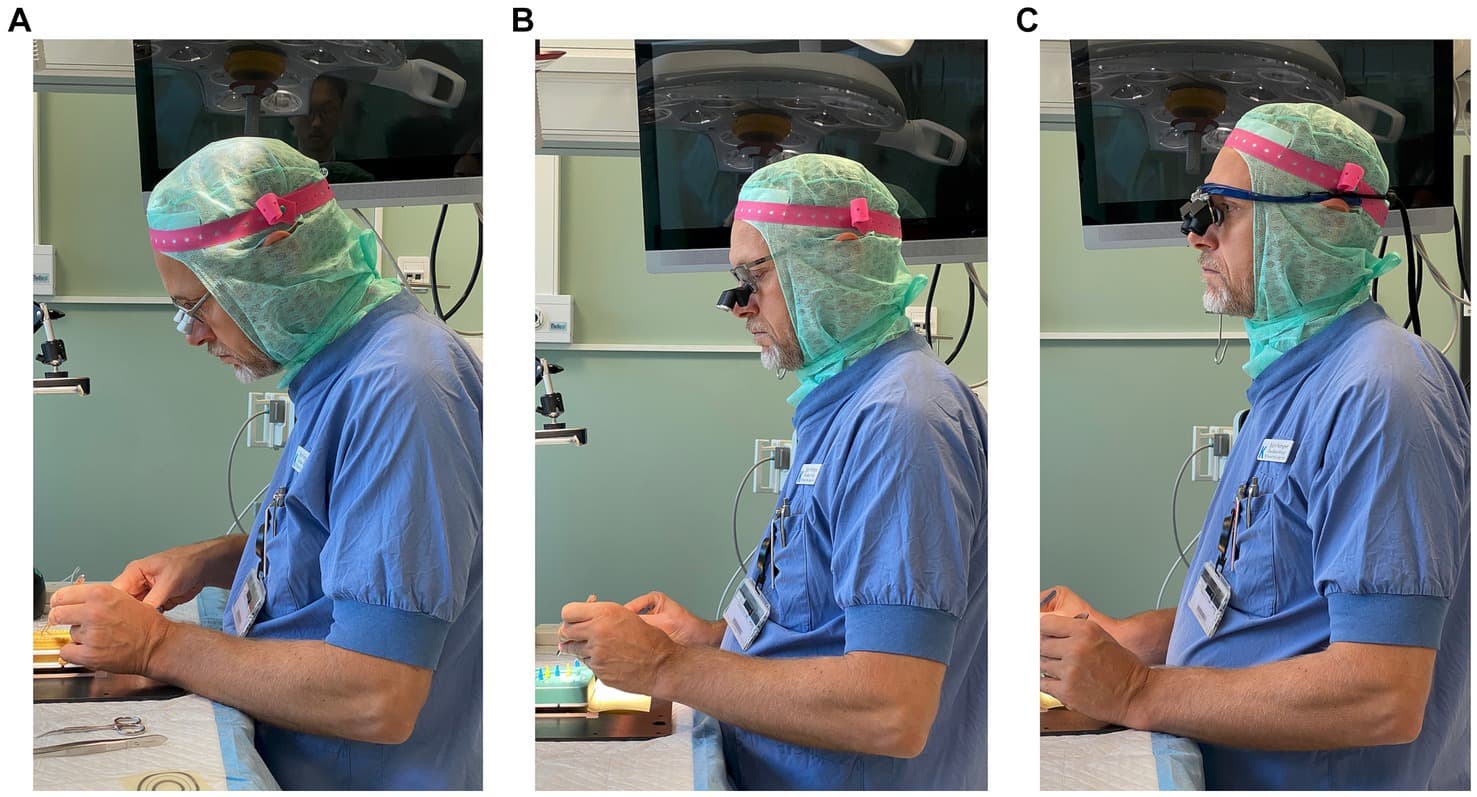
The most recent piece of high-quality evidence is a 2023 randomized controlled crossover trial of 19 surgeons (endocrine, head and neck, and vascular) at a Swedish academic hospital. The team compared three loupe conditions — traditional, low-tilt prismatic (15° prism angle), and high-tilt prismatic (48° prism angle) — across simulated surgical tasks, measuring head flexion, neck muscle activity, accuracy, time, and discomfort.
03
Head flexion drops sharply with prismatic optics
Head flexion is the posture variable that loads the cervical spine fastest. The trial showed that prismatic loupes cut median head flexion roughly in half compared with traditional loupes, and the effect scaled with the prism angle of the loupe.
04
Neck muscle activity follows the same pattern
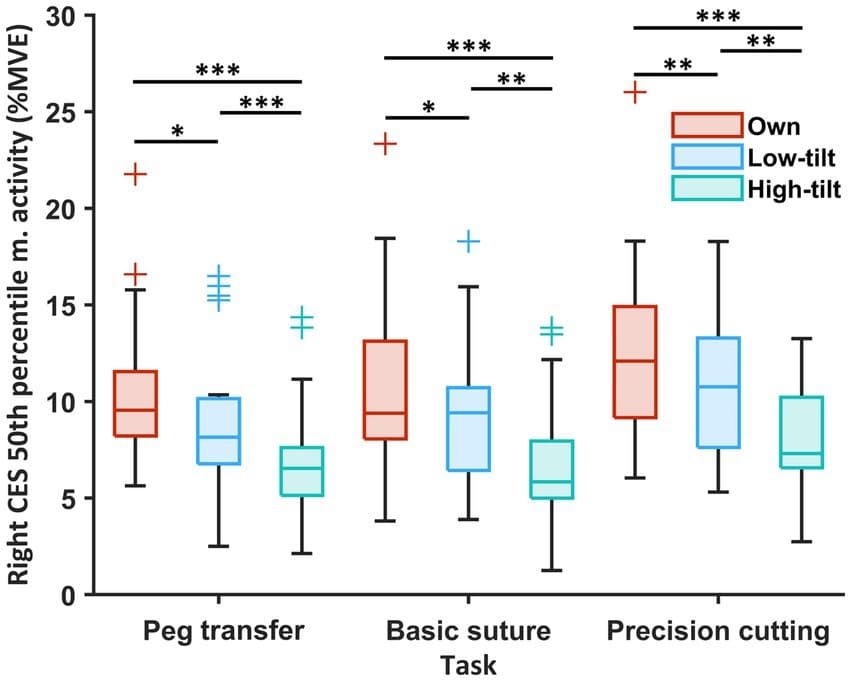
Lower head flexion translated directly into lower cervical erector spinae activation — the muscle group that holds your head up against gravity hour after hour. The reduction tracked the prism angle: more tilt, less muscle work to maintain visual axis.
05
Discomfort drops, accuracy holds, time penalty is modest
The trial measured three things at once: did discomfort fall, did accuracy hold, and did the surgeon get slower? The short-term answers in this study were yes, yes, and slightly — the high-tilt prismatic condition added roughly 11 to 15 seconds across two tasks, with surgical errors statistically unchanged.
Source: Mengelkamp et al. (2023). Frontiers in Public Health.
06
How HeliosX prismatic systems map to this evidence
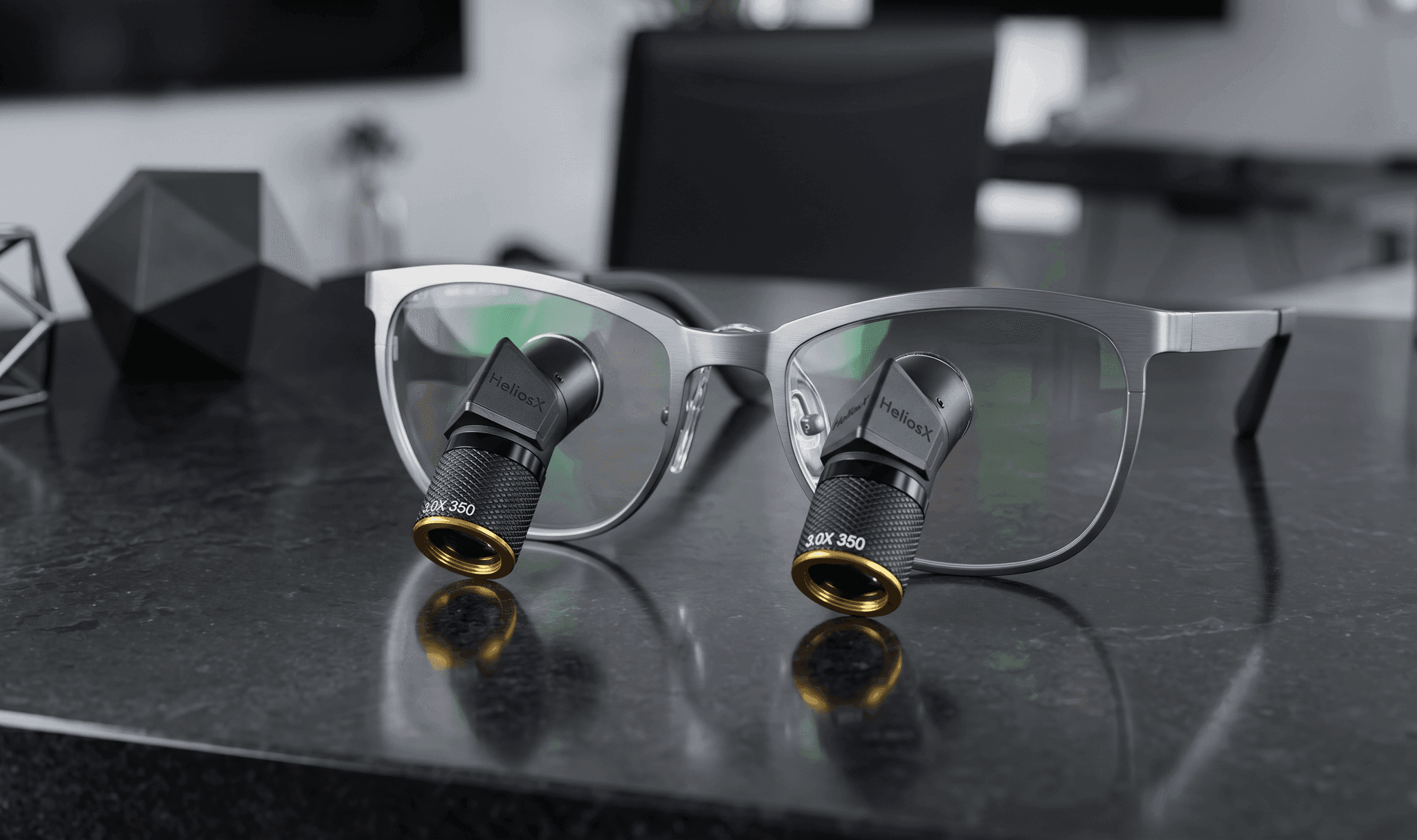
HeliosX Medusa and Apollo are both ergonomic prismatic loupe systems built around the same physical principle the Frontiers trial measured — a higher prism angle that pulls your eye line toward the operative field without forcing your head down. Medusa adds adjustable working distance for clinicians who alternate between seated and standing positions across a long case. Apollo is the fixed-distance ergonomic prismatic build optimized for procedural mixes that stay at one or two consistent working distances.
07
Fit variables that compound — or undo — the ergonomic benefit
Prismatic optics alone do not deliver the posture benefit. The same study and the broader ergonomics literature show that working distance, interpupillary distance, frame balance, and lighting all interact with prism angle. A prismatic loupe sized for the wrong working distance can put you right back into a flexed neck position.
08
Posture habits that still matter
Loupes change the posture math but do not replace good ergonomic habits. The lowest-flexion numbers in any study still depend on the surgeon using the loupes correctly, structuring breaks across long cases, and staying attentive to compensatory positions that creep in over time.
09
A responsible read of the evidence
Ergonomic loupes can support better positioning. They are not medical treatment. The Frontiers trial documents short-term physical workload effects in surgical simulation; long-term outcomes around chronic neck pain require ongoing research and individualized medical advice. HeliosX content is educational and does not replace clinical, occupational health, optometric, or ergonomic professional consultation.
Questions
Quick answers
Do prismatic loupes really reduce neck strain compared with traditional loupes?
A 2023 randomized crossover trial in Frontiers in Public Health measured a 22° to 26° drop in head flexion and a 32% to 42% reduction in cervical erector spinae muscle activity with high-tilt prismatic loupes compared with traditional designs. Self-reported neck discomfort was significantly lower with prismatic loupes (p = 0.006).
Can ergonomic loupes cure neck pain?
No product can promise to cure neck pain. Properly fitted ergonomic prismatic loupes can measurably reduce head flexion and cervical muscle load in surgical work, which may support better posture over time. Persistent symptoms should still be evaluated by a qualified healthcare professional.
What is the difference between Galilean and prismatic loupes for posture?
Galilean loupes typically have less prism angle and require more head flexion to bring the operative field into the line of sight. Prismatic loupes use internal prisms to fold the visual path, which lets the user keep a more upright head position for the same operative working distance. The 2023 Frontiers trial quantified that geometry difference at roughly 13° to 26° of reduced head flexion depending on prism angle.
Which HeliosX model is best for clinicians worried about neck strain?
Medusa and Apollo are HeliosX’s ergonomic prismatic systems. Medusa adds adjustable working distance for clinicians who alternate between seated and standing postures across a long case. Apollo is the fixed-working-distance ergonomic prismatic build for clinicians whose procedure mix sits at one or two consistent postures.
How important is working distance for the ergonomic benefit?
Critical. A prismatic loupe sized for the wrong working distance will pull you back into a flexed neck position to find the focal point. HeliosX measures pupillary distance and working distance after checkout so the prism geometry actually lands on your visual axis in the posture you actually use.
Will switching to prismatic loupes slow my procedures down?
In the 2023 Frontiers trial, the high-tilt prismatic condition added roughly 11 to 15 seconds across two simulated tasks, with no significant difference in surgical errors. The authors framed this as a modest time tradeoff for a measurable reduction in physical workload.
Related guides
Keep reading the education library.
Magnification guide
Loupe Magnification Guide
A practical resident-focused guide to choosing loupe magnification: 2.5x through 6.0x explained, specialty ranges, and a quick decision tool for first-time buyers.
Read guide →Optics comparison
Galilean vs Prismatic Loupes
Compare Galilean and prismatic loupes, including ergonomic prismatic systems like Medusa and Apollo.
Read guide →Measurements
Working Distance for Loupes
Learn what working distance means, why it matters, and how to measure it for surgical and dental loupes.
Read guide →PD guide
How to Measure Pupillary Distance for Loupes
Learn how to measure pupillary distance for loupes using an app, an optician measurement, or a careful manual method.
Read guide →Surgical evidence
Intraoperative Magnification by Specialty
Learn how surgeons across specialties use loupes and microscopes, and how intraoperative magnification choices change by procedure, setup, and anatomy.
Read guide →Resident buying guide
Best Loupes for Residents
How residents should pick their first pair of surgical or dental loupes — magnification by stage, specialty-by-specialty recommendations, and the HeliosX models that fit each.
Read guide →Shop by specialty
Match the right loupe to your work.
Surgical loupes
Ergonomic prismatic systems built for surgeons, residents, and procedural specialists.
Dental loupes
Posture-forward optics for dentists, hygienists, and dental students.
Best loupes shortlist
Compare HeliosX models side by side and find the right fit for your work.
Loupes for residents
Trainee-budget options that still deliver attending-grade optical performance.
Loupes for microsurgery
High-magnification builds for hand, plastic, ophthalmic, and reconstructive work.
Submit measurements
Pupillary distance, working distance, and the steps that ship your custom build.